This site is intended for US healthcare professionals.


Not actual patient.
SURVIVAL
May include permanent hearing loss1-2
Survival should be loud. But 60%-90% of cisplatin-treated patients may face permanent hearing loss.2-4
While PEDMARK doesn’t impact survival, it can help survivors hear their victories.5
Not actual patient.
PEDMARK: the first and only
FDA-approved therapy to reduce the risk of cisplatin-induced ototoxicity1‑3
Not actual patient.
Guidelines recommend sodium thiosulfate (PEDMARK), the only FDA-approved treatment to reduce the risk of cisplatin-induced ototoxicity (CIO), backed by 2 clinical trials2,5-7
Recommended for the Adolescent and Young Adult (AYA) population† by the NCCN Clinical Practice Guidelines in Oncology (NCCN Guidelines®)
These recommendations are not consistent with the FDA indication. Always refer to the sodium thiosulfate (PEDMARK) Prescribing Information and Instructions for Use.

NCCN Guidelines® for Adolescent and Young Adult (AYA) Oncology recommends sodium thiosulfate (PEDMARK) as a Category 2A preventative treatment option to reduce hearing loss associated with platinum-based chemotherapy in patients with localized non-metastatic tumors6
†NCCN Guidelines define an adolescent or young adult (AYA) oncology patient as an individual between 15 and 39 years.
NCCN makes no warranties of any kind whatsoever regarding their content, use or application and disclaims any responsibility for their application or use in any way.
NCCN=National Comprehensive Cancer Network.
Cisplatin fights for survival. PEDMARK fights to keep survival loud.1,2,5,8-10
The mechanism of action of PEDMARK is thought to counteract the effect of cisplatin by increasing endogenous antioxidants, scavenging reactive oxygen species (ROS), and direct interaction with cisplatin.5
For use in patients 1 month of age and older with localized, non‑metastatic, solid tumors5
- The safety and efficacy of PEDMARK have not been established when administered following cisplatin infusions longer than 6 hours
- PEDMARK may not reduce the risk of ototoxicity when administered following longer cisplatin infusions because irreversible ototoxicity may have already occurred

Not actual patient.

SIOPEL 6
PEDMARK demonstrated >40% reduction in the relative risk of hearing loss due to cisplatin5
Patients aged 1 month to 18 years receiving cisplatin chemotherapy for the treatment of standard‑risk hepatoblastoma.
Not actual patient.

Not actual patient.

COG
PEDMARK effectively reduced the relative risk of hearing loss1,5
Patients aged 1 to 18 years receiving cisplatin chemotherapy for the treatment of germ cell tumor, hepatoblastoma, medulloblastoma, neuroblastoma, osteosarcoma, or any other malignancy treated with cisplatin.5
Not actual patient.
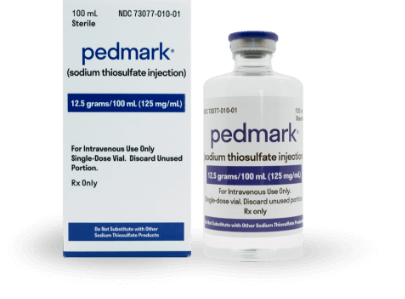
Almost 50 years after cisplatin’s first approval, PEDMARK can help reduce the risk of CIO5,11
PEDMARK is the first and only FDA‑approved treatment to reduce the risk of CIO. It can help protect what CIO could take away forever — based on 2 pivotal clinical trials.2,5,7

Not actual patient.

Plan for PEDMARK
PEDMARK must be infused as directed to minimize potential interference with the antitumor activity of cisplatin.5
Not actual patient.
Hearing protection shouldn’t come with logistical noise
Fennec HEARS™ provides support for access, logistics, and in-home infusions so you and your team can stay focused on care.
Call to learn more: 855-615-7946.

Cisplatin-induced ototoxicity prevalence may vary based on how or if hearing loss is assessed.
IMPORTANT SAFETY INFORMATION
- PEDMARK is contraindicated in patients with history of a severe hypersensitivity to sodium thiosulfate or any of its components.
- Hypersensitivity reactions occurred in 8% to 13% of patients in clinical trials. Monitor patients for hypersensitivity reactions. Immediately discontinue PEDMARK and institute appropriate care if a hypersensitivity reaction occurs. Administer antihistamines or glucocorticoids (if appropriate) before each subsequent administration of PEDMARK. PEDMARK may contain sodium sulfite; patients with sulfite sensitivity may have hypersensitivity reactions, including anaphylactic symptoms and life-threatening or severe asthma episodes. Sulfite sensitivity is seen more frequently in people with asthma.
- PEDMARK is not indicated for use in pediatric patients less than 1 month of age due to the increased risk of hypernatremia or in pediatric patients with metastatic cancers.
- Hypernatremia occurred in 12% to 26% of patients in clinical trials, including a single Grade 3 case. Hypokalemia occurred in 15% to 27% of patients in clinical trials, with Grade 3 or 4 occurring in 9% to 27% of patients. Monitor serum sodium and potassium at baseline and as clinically indicated. Withhold PEDMARK in patients with baseline serum sodium greater than 145 mmol/L.
- Monitor for signs and symptoms of hypernatremia and hypokalemia more closely if the glomerular filtration rate (GFR) falls below 60 mL/min/1.73 m2.
- Administer antiemetics prior to each PEDMARK administration. Provide additional antiemetics and supportive care as appropriate.
- The most common adverse reactions (≥25% with difference between arms of >5% compared to cisplatin alone) in SIOPEL6 were vomiting, nausea, decreased hemoglobin, and hypernatremia. The most common adverse reaction (≥25% with difference between arms of >5% compared to cisplatin alone) in COG ACCL0431 was hypokalemia.
Please see full Prescribing Information for PEDMARK.
INDICATIONS AND USAGE
PEDMARK (sodium thiosulfate injection) is indicated to reduce the risk of ototoxicity associated with cisplatin in pediatric patients 1 month of age and older with localized, non‑metastatic solid tumors.
Limitations of Use
The safety and efficacy of PEDMARK have not been established when administered following cisplatin infusions longer than 6 hours. PEDMARK may not reduce the risk of ototoxicity when administered following longer cisplatin infusions, because irreversible ototoxicity may have already occurred.